
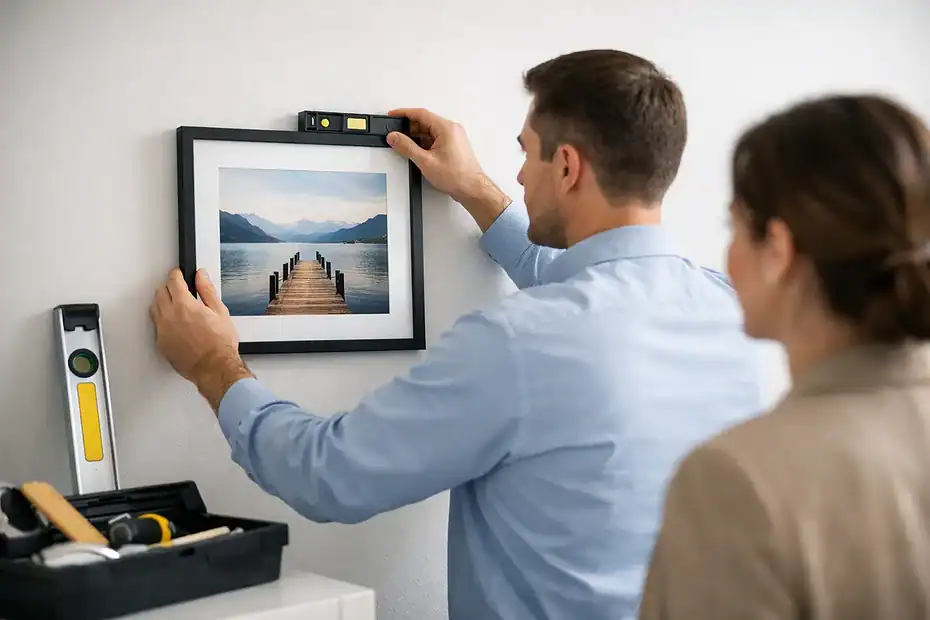
A picture that is off by half an inch can make the whole wall feel wrong. That is usually the moment people ask, how do professionals hang pictures so they look clean, level, and properly placed the first time?
The short answer is that professionals do not just put a hook in the wall and hope for the best. They plan the placement, assess the wall type, choose the right hardware, and install with both safety and visual balance in mind. That combination is what separates a specialist from a quick DIY attempt.
How do professionals hang pictures with accuracy?
Professionals start before any drilling happens. The first step is understanding the piece itself – its size, weight, frame construction, hanging points, and how it will sit in the room. A lightweight canvas over a sofa needs a different approach than a heavy framed mirror in an entryway or a set of artworks in a hallway.
Placement is never random. Professionals look at sightlines, furniture position, ceiling height, wall width, and nearby lighting. A piece may be technically centered on a wall but still feel visually off if it ignores the scale of the room or the furniture beneath it. Good hanging is part measurement and part visual judgment.
That is why experienced installers often mark reference points lightly, test the height, and confirm spacing before making any permanent holes. It saves the client from extra patching and gives the wall a more polished final result.
The real process behind professional picture hanging
A lot of people assume the job is mainly about tools. Tools matter, but the process matters more.
They measure from the hanging point, not just the frame
One of the most common DIY mistakes is measuring the outside of the frame and assuming that tells you where the hardware should go. Professionals measure the actual hanging point – whether that is a wire, D-rings, a cleat, or fixed brackets – and calculate exactly where the fastener must sit so the artwork lands at the intended height.
This is especially important with wire-hung frames, because the wire shifts under tension. If you do not account for that, the piece often ends up lower than expected.
They match hardware to the wall and the weight
Drywall, plaster, brick, concrete, and tile all behave differently. So do picture hooks, anchors, screws, wall mates, and masonry fixings. A professional chooses hardware based on both the wall surface and the load it needs to carry.
This is where safety comes in. A heavy mirror may look fine when first installed with the wrong fixing, but over time that choice can fail. Professionals build in a margin of security, especially for valuable art, large statement pieces, and items installed in high-traffic areas.
They check level, spacing, and visual balance repeatedly
Professional hanging is not a one-check job. Installers usually verify the level during setup, during fixing, and after the piece is mounted. On gallery walls or multi-piece arrangements, spacing is checked across the full grouping, not just between two frames at a time.
That matters because a layout can be mathematically even and still look wrong if the visual weight is uneven. A skilled installer adjusts for that.
Why professional results look better
The difference is often subtle until you have seen both versions side by side. A professionally hung piece usually feels settled in the space. It relates properly to the furniture, leaves enough breathing room, and sits at a height that feels natural rather than awkward.
In homes, that can mean artwork above a console that does not float too high. In offices, it can mean reception wall pieces that align cleanly and reinforce a polished first impression. In apartments, it often means getting strong visual impact from limited wall space without making the room feel crowded.
There is also a practical advantage. When a specialist installs the piece correctly, you are less likely to deal with crooked frames, loose fixings, unnecessary wall damage, or the need to redo the job later.
How do professionals hang pictures in tricky situations?
Straightforward walls are one thing. The real value shows up when the installation is more complicated.
Heavy items
Large mirrors, oversized framed art, and substantial commercial pieces need more than a standard hook. Weight distribution becomes critical, and so does the condition of the wall. Sometimes the best solution is two-point fixing. Sometimes it is a French cleat. Sometimes the wall itself limits the options, and that changes the placement or hardware choice.
Plaster and older walls
Older walls can be less predictable than modern drywall. Plaster may crack, crumble, or hide inconsistencies beneath the surface. Professionals know how to reduce damage, pre-drill correctly, and avoid fixings that may not hold well in aging material.
Grouped arrangements
A set of three frames sounds easy until one sits slightly higher than the others or the spacing starts to drift. Professional installers map the entire arrangement first, often using a measured layout rather than placing each piece one by one by eye. That keeps the overall composition tight and intentional.
Stairwells and high walls
These areas are visually powerful but harder to execute. Height, ladder safety, viewing angle, and alignment all become more complex. Professionals account for how the artwork will be seen while moving through the space, not just while standing still at floor level.
The tools professionals rely on
Professionals typically use lasers, stud finders, precise measuring tools, suitable drill bits, wall-specific anchors, and protective materials to keep both the artwork and the room in good condition. But tools alone do not guarantee a good finish.
Knowing when not to use a stud, when to center over furniture instead of centering on the wall, or when to adjust spacing to suit frame thickness is what turns a technically correct installation into one that actually looks right.
That is also why many clients call a specialist after trying it themselves. The problem is rarely effort. It is that picture hanging asks for exact measurement, hardware knowledge, and design sense at the same time.
Common mistakes professionals avoid
The biggest one is hanging everything too high. It happens constantly, especially in rooms with tall ceilings. Professionals typically anchor placement to how the piece relates to people and furniture, not just to available empty wall space.
Another common issue is underestimating weight. Frames can be much heavier than they appear, particularly with glass, thick mats, or solid timber construction. Using hardware that is only just adequate is not a good long-term plan.
Spacing mistakes are also common. When pieces are too far apart, they stop reading as a set. When they are too close, the wall feels cramped. Professionals adjust based on frame size, room scale, and what sits around the artwork.
Then there is the wall damage factor. Extra holes from trial and error, chipped plaster, cracked paint, and poor patch points can all make a simple job more expensive than expected.
When hiring a professional makes the most sense
If the piece is valuable, heavy, oversized, or part of a multi-piece arrangement, professional installation is usually the smart move. The same goes for mirrors, stairwells, commercial fit-outs, rental properties where wall damage matters, and homes where presentation is a priority.
It also makes sense when time matters. For many homeowners and office managers, the real benefit is not just technical skill. It is having the job done efficiently, neatly, and without second-guessing.
A specialist service like HanGsy is built for exactly that kind of work – secure installation, careful placement, and a finished result that looks considered rather than improvised.
What to expect from a professional hanging service
A good installer should ask about the item size, weight, wall type, and the room itself. They may also ask for photos ahead of time, especially for larger jobs or grouped layouts. That helps them plan the right fixings and estimate the work accurately.
On site, the process should feel organized. Placement is confirmed before drilling. Hardware is selected for the specific wall. The piece is installed securely, checked for level, and finished cleanly.
That is the standard clients should expect, whether they are hanging one family portrait in a living room or fitting out a full office wall with branded artwork.
If you are looking at a blank wall and wondering where to start, the best answer is usually the simplest one: the right picture deserves more than a rough guess. A well-hung piece does not call attention to the installation itself – it just makes the whole room feel finished.
Pingback: Apartment Picture Hanging Service Done Right - HanGsy
Comments are closed.