
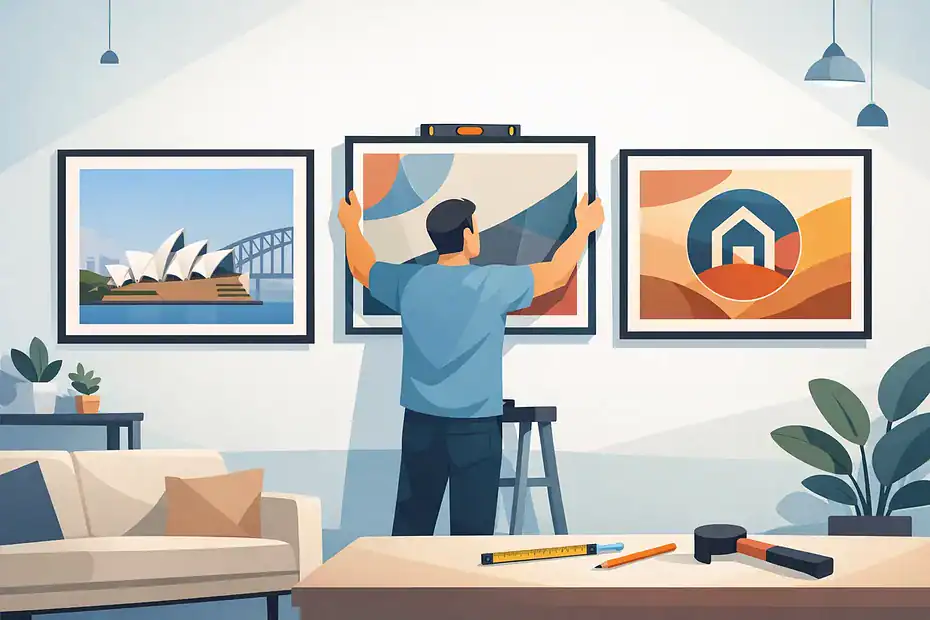
A large piece of art can make a room feel finished in seconds – or make the whole wall look off if it is hung too high, slightly crooked, or fixed with the wrong hardware. That is why a large artwork hanging guide is less about guesswork and more about getting three things right from the start: placement, support, and precision.
For homeowners, office managers, and anyone working with a statement piece, the challenge is usually not deciding whether the artwork looks good. It is figuring out how to hang it securely without damaging the wall or ending up with a result that feels awkward every time you walk past it. Big artwork draws attention, so even small mistakes become obvious.
What makes large artwork harder to hang
Large artwork is less forgiving than smaller frames. It has more visual weight, it often needs two points of support instead of one, and the wall itself matters much more. A lightweight print in a slim frame can sometimes be repositioned with minimal fuss. A large framed artwork, canvas, or mirror is different. Once holes are drilled, patching and repainting become part of the cost of getting it wrong.
The size of the piece also changes how people read the room. When artwork is too small, the problem is usually decorative. When artwork is too large or badly placed, it can throw off the balance of the entire space. This is especially true above sofas, beds, consoles, reception desks, and meeting room furniture where spacing needs to feel deliberate.
There is also the handling side. Bigger pieces are harder to lift, level, and secure evenly. If the frame is valuable, glazed, or unusually heavy, the risk is not only wall damage. It is damage to the artwork itself.
Start with placement before hardware
Most hanging problems begin before the first tool comes out. People often focus on hooks and anchors first, when the real question is whether the artwork is going in the right spot.
The center of the artwork should usually sit around eye level, but that rule shifts depending on the furniture below it and the scale of the wall. Over a sofa or console, the artwork generally looks best when it feels visually connected to the furniture rather than floating far above it. Leaving too much gap creates a disconnected look. Hanging it too low can make the room feel cramped.
A useful way to think about placement is proportion. If the wall is large and open, the art needs enough breathing room around it. If it sits above furniture, it should relate to that furniture in width and height. A piece that is roughly two-thirds to three-quarters the width of the furniture below often feels balanced, though there are exceptions with oversized statement pieces.
This is where a practical test helps. Before committing, tape out the dimensions on the wall or hold the artwork in place with a second person. Step back. Sit down. View it from the doorway. Large art should look intentional from multiple angles, not just straight on.
A large artwork hanging guide to wall types
The wall type changes the installation method. This is one of the biggest reasons large artwork hanging can go wrong.
Drywall is common, but drywall alone is rarely enough for heavy pieces unless the correct anchor system is used. If a stud can be used, that is often the strongest option. If not, the right heavy-duty anchor matters. The wrong anchor may hold briefly, then loosen over time.
Plaster walls can be trickier. They may crack if handled roughly, and locating solid fixing points can be less straightforward than in standard drywall. Brick and concrete offer strong support, but they need the right drilling equipment and masonry fixings. Tile, stone, and other hard surfaces raise the stakes even more because mistakes are difficult and expensive to hide.
In commercial spaces, wall conditions can vary from one room to the next. What works in a reception area may not be suitable in a corridor or boardroom. If the piece is heavy, fragile, or installed in a high-traffic area, secure fixing is not optional.
Hardware matters more than people expect
The hardware on the back of the artwork is only half the picture. The fixing method inside the wall matters just as much.
D-rings with wire are common, but wire can make precise leveling harder on large pieces. In many cases, two fixed hanging points give a cleaner and more stable result. They help reduce shifting over time, which is especially useful in homes with vibration from doors closing or in offices where walls are regularly bumped.
Sawtooth hangers are generally not the best choice for large or valuable artwork. They are simple, but they offer less control and stability. Heavier pieces often need rated hooks, anchored screws, or bracket-style support depending on the frame construction and wall material.
Weight ratings should never be treated as a rough suggestion. They need a margin of safety. That means factoring in the frame, glass, backing, and any future movement. If the artwork is close to the upper limit of the hardware rating, it is worth rethinking the method.
Measuring for straight, balanced results
The visual side of hanging large artwork is where experience shows. A piece can be technically secure and still look wrong.
The most common issue is height. People tend to hang large artwork too high, especially on tall walls. That happens because they are reacting to the wall size instead of the room’s sightlines. Bigger wall does not automatically mean higher placement.
The next issue is centering. The artwork should usually be centered in relation to the furniture or architectural feature beneath it, not necessarily centered on the entire wall. Above a bed, that means centering to the bed. In a hallway, it may mean centering to the visible wall span. In an office, it may be about aligning with desks, joinery, or reception counters.
Then there is leveling. On a large piece, even a slight tilt is obvious. Measuring from the frame alone is not always enough because some frames are not perfectly square. It helps to check both the frame and the visual relationship to nearby features like ceilings, shelving, and furniture lines.
When DIY works and when it does not
Some large artwork can absolutely be hung without professional help. If the piece is moderately sized, the wall type is simple, the hardware is appropriate, and you are confident measuring accurately, a careful DIY installation may be reasonable.
But there are clear cases where it makes sense to bring in a specialist. If the artwork is heavy, expensive, glazed, oversized, or going onto plaster, masonry, tile, or a difficult wall surface, the cost of a mistake rises quickly. The same applies if you are hanging above stairs, in a commercial setting, or as part of a multi-piece layout where spacing needs to be exact.
There is also the time factor. Many people can hang one piece eventually. What they want is to have it done properly the first time, without extra holes, repeat measuring, or that lingering feeling that it is not quite right. That is often where a dedicated hanging service adds real value.
Why professional installation changes the outcome
A specialist installer brings more than tools. They bring judgment about placement, wall conditions, load support, and final presentation.
That matters because hanging large artwork is part technical job and part visual decision. Secure installation is non-negotiable, but so is getting the height, spacing, and alignment right for the room. A professional who works with art, canvases, and mirrors every day can spot issues before they become expensive corrections.
For design-conscious homes and polished commercial spaces, that combination matters. The piece needs to stay secure, but it also needs to feel like it belongs exactly where it is. That is the difference between something being merely mounted and being properly installed.
In Sydney homes and workplaces, clients often want that done without the hassle of sourcing hardware, checking wall types, or coordinating multiple attempts. That is where a specialist service like HanGsy fits naturally – qualified installers, precise placement, and the reassurance that the final result will look clean and hold properly.
Common mistakes worth avoiding
Most installation problems come down to rushing. People estimate instead of measuring, rely on generic hardware, or choose placement based on an empty wall rather than the room as a whole.
Another frequent mistake is ignoring how the piece will sit over time. If the frame can shift easily on the hook, or the anchor is barely suitable for the weight, the artwork may not fail immediately. It may just slowly lean, slide, or loosen.
The final mistake is treating all large wall pieces the same. A stretched canvas, a glass-fronted frame, and a heavy mirror may look similar in size, but they do not behave the same way on the wall. Each needs its own installation approach.
A good result should feel quiet. The artwork looks right, the wall stays intact, and nobody has to think about whether it is secure. That is usually the best standard to aim for when the piece matters.